
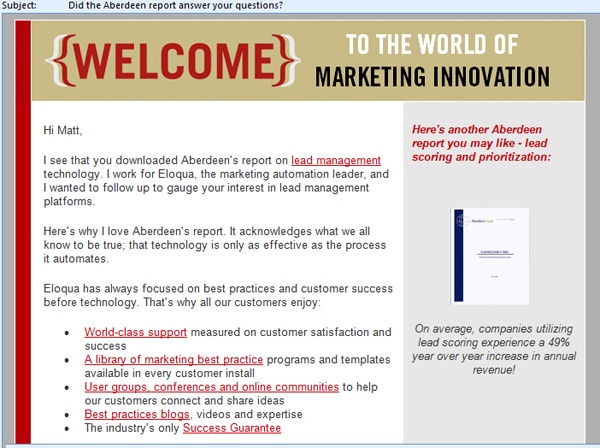
A few weeks back, I received a truly excellent whitepaper follow-up email from a sales rep. The email so impressed me that I immediately shared it with my team as an example of what to do.
Since Trish recently shared The Worst Sales Email EVER, I wanted to put up this email as its direct antithesis.
What I liked
- A Reference and link to the specific item that interested me
Far too often, Inside Sales Reps will make passing mention of "the whitepaper you downloaded". By being specific, it shows that the Rep is tuned in to the topic that originally got my attention and make the email instantly relevant to me.
- A conclusion based on the report
Better than a reference to the item I downloaded, Reps can share their impression, or a notable conclusion, from it. While not requiring profound analysis, these comments will set Reps apart in that they aren't simply "following up," but have some insight into why I would have downloaded the report in the first place.
- It offered addtional value
I particularly like that (at right) another related and relevant piece of content is offered to me. This isn't simply the next webinar or latest download piece, but a complimentary report to what I already responded to.
. - It sells the conversation
I've shared my thoughts on that topic before. I appreciate the way that the Rep gives me the option to raise my hand and say "You know what? You seem like you might get what is is I do here. Let's talk."
So what's the takeaway?
I ran across this article from Ardath Albee Staying Top of Mind is Not the Goal for Email Marketing. To re-work her conclusion (bold being my words):
In essence, checking in must become selling the conversation. Checking in is tactical. Selling the conversation is strategic. It's a different mindset. The process of selling the conversation helps companies focus on prospects, instead of on themselves. And that's what matters to your buyers.
I am very interested in your thoughts. Please share in the comments.