
Somewhere an enablement leader just opened a spreadsheet with 23 tabs labeled SKO 2027. Planning is officially underway for one of the largest investments of the year.
Between travel, hotels, venues, employee time away from customers, and the countless hours spent planning, the total investment in a Sales Kickoff (SKO) can easily reach hundreds of thousands of dollars. Yet too often the learning and excitement wear off faster than the jet lag.
We continue to treat SKO as the event that will drive change and “make this year better than the last,” rather than one part of a larger effort to improve performance. Preparation is squeezed into an already chaotic end of year, and post-event reinforcement largely falls to frontline managers who are already stretched thin.
SKO: Same Kickoff, Obviously?
Preparation and reinforcement aren't new ideas. Enablement leaders know they matter; finding the capacity to execute them consistently is another story. Enablement teams are buried in planning and content development, sellers are trying to close the year, and frontline managers are already struggling to find time to coach.
But we don’t have to accept a Groundhog Day fate. AI is making it possible to close the gap between what we know works and what we actually have the bandwidth to execute. AI Trainers and Coaches make it practical to deliver personalized preparation and ongoing reinforcement without adding a mountain of work to everyone's plates.
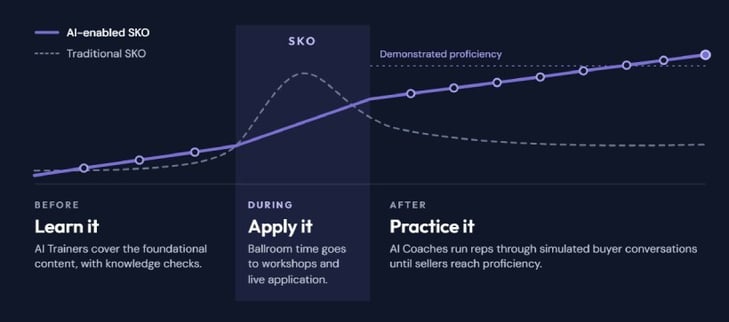
Before SKO
Think about how much time at SKO is spent delivering information: product updates, competitive positioning, new messaging, and other foundational content. Some of that absolutely deserves time on the agenda. But much of it could be learned beforehand, freeing up valuable time together for actual application instead of watching sellers slowly sink into their chairs, wondering how long until the next snack break.
Prework isn't a new concept, but let's be realistic about how it typically happens.
For organizations running SKO in January, preparation usually falls in December, when sellers are trying to close the year and enablement teams are already buried in event planning. Asking sellers to attend another 90-minute training session or squeeze hours of prework into their already packed schedules is about as likely as a prospect not asking for a year-end discount. And even when prework is assigned, it's often the same videos, presentations, or reading assignments for everyone, regardless of their experience or existing knowledge. There's little opportunity to ask questions or get clarification, and completing the assignment ends up as more of a “check the box” exercise than a true learning experience.
So now we're back in the hotel ballroom, using some of the most expensive hours of the year to get everyone caught up on the basics.
And before you suggest recording the live presentation and sending it out afterward, we both know how many people are actually watching that.
Let's say you're rolling out new messaging for one of your products at SKO. Before the event, you assign a few short AI Trainer modules covering the updated value proposition, target buyers, and key differentiators. Sellers can ask questions as they go, and knowledge checks help confirm they understand the new narrative. Now, instead of spending an hour at SKO walking everyone through the messaging deck, you can jump straight into workshops where sellers practice positioning the product in real-world selling situations.
And with everyone arriving with a more consistent baseline of knowledge, you can spend less time getting people up to speed and more time keeping everyone engaged, from the seller who joined last week to the veteran attending their fourth SKO.
After SKO
Everyone heads home motivated, armed with new messaging, methodologies, and a renewed commitment to doing things differently. Then Monday rolls around, the inbox has 147 unread emails, and it's back to business as usual.
The real test comes when sellers have to put everything they learned into practice. Maybe that's running better discovery calls, handling objections more effectively, or changing how they position your platform. Within days, we're reminded that sitting through a great workshop doesn't magically translate into doing those things well.
We all know reinforcement matters. Making it happen is another story.
Once SKO wraps, responsibility typically falls to frontline managers who are already juggling forecasts, pipeline reviews, deal support, and everything else that comes with the job. The result? A few reminders during team meetings, some occasional coaching, and a whole lot of hope.
Where AI Trainers build knowledge, AI Coaches build skill.
Let's stick with that new product messaging you rolled out at SKO. In the weeks that follow, sellers work through a series of AI Coach simulations where they have to actually use the new narrative. Maybe they start with a straightforward conversation explaining the product's value to a potential buyer. From there, things get a little more interesting. They practice with different buyer personas, each with their own priorities and objections. A technical buyer might question how the product works with their existing systems, while an executive wants to understand the business impact. Sellers get feedback on how well they're applying and adapting the messaging, with opportunities to repeat scenarios and improve before trying it out on actual customers.
And one of the best parts? No one has to convince a manager to play the skeptical buyer for the fifth time that week. AI Coaches don't replace manager coaching. They take on repetitive practice and initial feedback, so managers can focus their time where it matters most: helping sellers apply those skills in real deals.
Now we can build reinforcement into the weeks and months following SKO, instead of adding it to the manager's to-do list and crossing our fingers that it actually happens.
Finding the "R" in ROI
We've all seen the post-SKO surveys. Great energy, great sessions, great food (hopefully). Everyone leaves feeling inspired, and the event gets glowing reviews. But fast-forward a few weeks. Are sellers actually doing anything differently?
AI coaching gives us a way to look beyond attendance and satisfaction scores to answer more meaningful questions:
- Are sellers actually practicing?
- Where are they struggling?
- Are their skills improving over time?
- Have they demonstrated the proficiency we expect?
But even demonstrated proficiency is only part of the picture. We still need to see those skills showing up in actual customer conversations. If SKO introduced a new discovery methodology, for example, we should be looking at the quality of discovery calls and whether opportunity conversion rates improve over time. That's how we start connecting what sellers learned, what they're doing differently, and whether it's making a difference to the business.
Rave reviews of the chocolate fountain are nice. But they aren't ROI.
A New Flow to SKO
Same objectives. A much better chance of making them stick.
We've spent years perfecting the art of putting on an SKO. The agendas, the keynote speakers, the team dinners, and the occasional questionable entertainment choice. But for all that effort, the preparation and reinforcement needed to make the investment pay off have often taken a back seat.
If we're going to invest hundreds of thousands of dollars in three days together, we'd better have a plan for the other 362.

Alex is a coach at heart who believes better sales performance starts with helping people get better at their jobs. Before moving into SaaS sales, enablement, and GTM consulting, she coached competitive rowing and trained guide dogs and the people who rely on them. She helps revenue teams strengthen seller skills, simplify workflows, and improve sales productivity.